


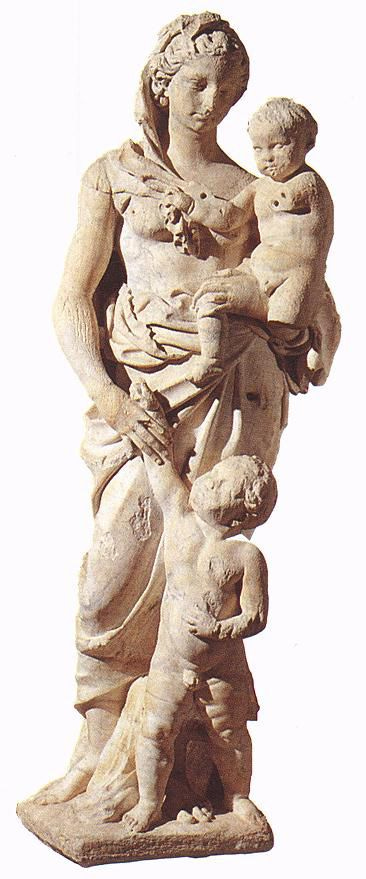
_-_Siena_2016.jpg)
The story of Rhea Silvia is the story of a woman of pre-Roman Latium whose life is overtaken by the forces of war. A woman who loses her city, her family, her children. A woman whose mother (by my telling) comes from forest people, deer-hunters and black-pottery sculptors, and whose father is one of the descendants of the mythic Trojan Aeneas (of Virgil’s Aeneid fame).
I’m sharing this story in two parts this weekend and next for all my readers, accompanied by the audio-recording I made of it several years ago on my podcast, Kalliope’s Sanctum. You can find this recording at the end of the post, both as an embedded track and with a link to the podcast in case you would prefer to listen there.
This novelette was originally published in my short story collection Our Lady of the Dark Country, but I’m making it fully available here together with the audio as an offering to this time of incredible grief and violence—as one sort of mythic lens with which to approach it; as a story dedicated to the unveiling of imperialistic violence; as a prayer for mothers and fathers and their children, for husbands and wives, for family lineages.
I wrote “Rhea Silvia” six years ago, after time spent in Southern Italy, where I saw a worn sarcophagus depicting scenes of the euphemistically titled “union” of Mars and Rhea Silvia, the suckling of Romulus and Remus by the great mother-wolf, and the Tiber River as an anthropomorphic god who saves Rhea when she has been thrown into the water to be drowned, and becomes her true husband.
I remember standing in front of that carving somewhere in a little museum in Salerno I think. I remember that I could already feel the story beginning to take shape. Rhea Silvia’s voice guided me strongly throughout the writing process. These pages came through in a handful of weeks. I listened, and wrote what I heard her tell me about herself, as all writers do with the characters who come to them that way. She remains perhaps the most beloved-to-me voice I’ve ever written. I couldn’t tell you why, only that she haunted me, and haunts me still. That she moved me, that she felt very close to my heart, that I loved and mourned right alongside her. That it was a terrifying, heart-breaking story to listen for. That her dignity and her courage changed me, by touching her with my words.
Rhea forest-woman.
Rhea wolf-mother.
Rhea who loved the river god.
Rhea, whose children were fathered by War.
Rhea, who was taken from her children.
Rhea, whose heart broke many times.
Rhea, whose children founded the war-state called Rome.
Rome, whose ideologies we are still ruled by. Rome the conqueror. Rome the crucifier.
But Rhea is still beside the Tiber, her true husband, waiting for her boys to return to her as they were when they were born.
Here is her story.