


Upcoming Events
Swanskin: A Story of Swan Woman
June 13th from 6:00-8:30 at St Columba’s, Inverness CA
tickets here, they are going fast!
The Island Daughter & the Green Knight
a day of storytelling and animal tracking
June 20th from 10:30 am - 4:00 pm, Point Reyes Peninsula
Hello dear readers,
May has felt like a tidal month, cupped by full moons so bright and big I’ve been pulled out into uncharted waters again and again. But each time, at each moon, the moon herself has fished me out. I am Grandmother Weaver, she says to me. I am Grandmother of the Blood Cycle. I am Grandmother Maker, Grandmother Bone, Grandmother Seaworthy Vessel. Come my love. I see your white flag, hoisted up above your tattered sails. Here is my shore. Here, lay out your sails, we will reweave them together.
She reminds me to speak to the four directions at daybreak— east across Tomales Bay to the sunrise, south toward the whale’s tail edge of Point Reyes at the Bolinas Lagoon, west across chaparral and pinewood and coastal dunes to the great Pacific Ocean and the faithful sunset, and north to the hummingbird-beak tip of the peninsula at Tomales Point, which the stars of the Great Bear guard through the night. These are threads, she reminds me. You can mend your sails with them.
I think we are all in deep water right now. All in need of sail mending. There’s a feeling in the air of accelerated unravelling, but it feels like an unravelling where all of the threads are tangled, knotted, where we are losing our sense of meaning, our tethering to dirt-air-fire-water-heartbreak-heartbeat reality, our umbilical orientation to life. The way things are needs to unravel, but this feel slippery, as slippery as the latest iPhone screen, where fingers glide and flick ten million years of Earth’s resources into immediate but false comfort and ease. Slippery like our sense of reality is slipping right out of our hands. We need to undo the way this story we are in right now has been woven, yes, but we still need our understanding of the threads themselves to remain intact, even if we have to spin new ones, and this is what I’m worried about.
I’ve been avoiding writing about AI for some time, largely because I’ve been in some kind of profound denial about its existence to begin with, its arrival everywhere, its infiltration of every online space, and the ways in which it is profoundly affecting the written word (in English especially) everywhere I look, not to mention our humanity. I think it’s accelerating this slippery, all shores are gone and our sails are gone too feeling at breakneck speed, and I think we aren’t remotely equipped to handle it. It’s making it very hard for me to know how to relate to any online content anymore, including Substack. This space is not what it was before. What a few years ago felt like a fresh set of journal pages and an intimate, personal place to publish new ideas as a writer, now feels like just one more social media website, rife with AI illustrations that make my head feel seasick and my spine go cold, and so much “hot take” content (so often with that awful AI tone and cadence seeping in) that no matter how meaningful some of it might be, the net result is still overwhelm.
This recent interview between Stephen Jenkinson and Kimberly Ann Johnson is the first time I’ve actually even been able to listen to a conversation about AI— I am that disturbed by it, that alarmed, that emotional. Their conversation grounded and eased something in me, even as it set all my alarm bells off too. But it kept me company. It helped me look. If you are needing that company too, I highly recommend it.
I pray to God it goes without saying that I will never, in any way, allow AI to touch my writing, or anything else of my work or brain. I have never used it (knowingly— and the fact that I have to say that makes me furious). I actually don’t even know how to engage with ChatGPT, or where it is that one finds it. I hold my pen and ink, my paper, my fingers, my mind, the channel between my body, spirit and the living world which is the channel through which I write, absolutely sacred— and even if it means that my writing or books or work will not be able to “keep up,” I accept that fate as the offering and humbling and sacrifice needed to remain in true relationship to sun, wind, sky, stars, earth, water, heart, body and soul. And my own sanity.
I don’t trust what Substack or anywhere on the internet is doing to the state of writing right now. I don’t like what it’s doing to our precious medium as writers, our rhythms, our letters, our craft. I don’t like the absolute deluge of it. I don’t like what it does to the quality of my own work. I don’t like how it makes things look and feel finished when they aren’t at all, when they are half formed or less, when they are dough. The best words are ones that are hard won and long gestated. Words you can tell a writer turned over and over in their whole body for months or years. I don’t mean specific sentences, I mean the craft and skill behind them. The attention to rhythm, structure, color, seeing, how life has stained herself through them in order for those words to come out. I want my writing to never lose that quality. I want the writing I read to have that quality. I worry about our brains, about our eyes, about our inner ears, about our dreams. I worry about my own brain, my own eyes, my inner ear, my dreams.
Sometimes I wonder about abandoning this space, like I already have Instagram. Other times I wonder if I made a mistake by abandoning even Instagram—I make a living entirely from my writing and my teaching and my storytelling, and I need to be able to reach out, to feel you there, to send you word of what’s being written, dreamed, born. If these are the only ways to find each other right now, how do we navigate the dangerous numbing rivers that they are predicated upon, that we are sailing upon? I think about how the word viral comes from virus. Something that makes you sick. I wonder how we resist the addiction built into these spaces, built to wire right into our animal hungers, our animal longings, our warm-blooded loneliness.
I don’t know what happens when my eye reads letters on a plasma screen, but I don’t like how it feels. One part of me eats it hungrily, rapidly, fast as salty fries. Another part of me feels stunned like a fish in water is stunned by poison, stunned and gawping, my eyes bulging like a fish’s eyes, hardly blinking, staring like we do at danger, frozen in place. I’m not looking at tree pulp paper and ink however bleached, however inorganic the chemical ink. I am looking at liquid crystal pixels that are manipulating too much light into my eyes, so much light we can’t sleep at night when we look too long.
I know that every day I am looking at too much light, but not the kind that comes out of stars or skies, not the kind that shifts through the day as it shines in the window. The light coming through this computer screen, it is immensely powerful. It is its own magic. I need it for my manuscripts, for the way we create books now. But I want to wield it with far more care, with far more attention to what that amount of light, shining through my eyes all day into my brain is doing. What is this kind of endless false light doing to the mystery places in my psyche? To the seed places where words grow and absorb winter rain, where they retain the soil of the world on them?
Words are becoming cheap, words are becoming flat, flatter than flat. We are in a dangerous wash of them, a delusion of them. We are all sugar and cocaine, no bitter root, no grounding, no digestion. I can tell when I’m reading a book that was written before the spiraling out of control addiction so many of us have to the iPhone and the swipe screen. I can tell when I’m reading a book that was written before 2018/2019. I can also tell when I’m reading book written before the internet, or by someone old who very rarely uses it. With each, I can feel the brain of the writer working differently. More steadily more attentive, far sharper and far more alive. I taste bitter roots, granular focus, the barbs between the filaments of a bird feather. The words of writers from before the 20th century are an even more powerful bitter, a more powerful pharmakon. They are nocino, they are drops of wine from the oak barrels of eastern Crete, they are raki made in copper stills to the sound of old hunters singing mantinades. That’s how they feel in my brain.
I’m turning all of this over and over in myself these days. Humbled by my own addictions, concerned for my own craft and brain, trying to see clearly, to know how to move. Will there come a point when the threads in our brains are worn too thin to come back from it all? When our in-dwelling mycelial intelligence is too starved of nourishment to come back to life? When even our own Moirai, our spinning fates, the ones who were there at our births and spoke our destinies over our umbilical cords while they spun long threads, don’t know how to reach us?
I pray to Grandmother Moon to bring bitter milkthistle back into my work. Bitter dandelion root, bitterness of artichoke liquor. Bitterness of the wild hyacinth bulbs they eat in Crete that have to be cooked three times to get the tannins out so they are just about edible. I was afraid the first time Giannis made them for me, because their bitterness stunned me. But maybe we need to be stunned like that, woken up like that, back to the rhythms of our own animal digestion.
I can hear Grandmother Moon saying—the danger is not that you will not know how to regrow your mycelial wisdom. If it all came crashing down the animal knowing of your human bodies will rise up, come clean, rinse your brains out with bitter medicines and rain. That’s not the danger really. The danger is that until then, you will live in a state of forever-forgetting, drifting, slipping through time. You will be in a slipstream, the river Lethe, a Hadean river made toxic by the mines where we get our gold, cobalt, copper, nickel, titanium, to run the liquid screens. And your life, this precious life given to you by Earth and Sky and Love, will slip past you, half given over to corporations who are stealing the water from the ground beneath your feet and the clean air from your own lungs.
So, she says, start by calling your dreams back fully into your own psyches now, into your own hands and feet. Call them away from the too-bright screen as often as you can, back in to your hands’s eyes, and let them rest in you and be born from you. Hand letter them, hand paint them, sing them. Hold them close. Don’t post photos of them, for the love of all that is holy. Resist the urge, resist, resist, the urge to let the market that has poisoned Earth’s waters to mar these dreams in you too. Wait until they are matured by the elements. Wait until you understand what you are feeling, and why you do what you do, and what hunger lies beneath it.
Meanwhile, mend your sails. They are in tatters.
I have been taking Grandmother Moon’s words to heart. Her words remind me of Calypso, mending Odysseus’s sails on her otherworldly Ogygia. According to the brilliant research of Emily Hauser in her book Mythica: A New History of Homer’s World Through the Women Written Out of It, for one woman to spin and weave the cloth for new sails all by herself, it would take her around seven years.1 The exact length of time Odysseus was “trapped” on her island. Maybe, Hauser argues, he was trapped not because of her seductive wiles, as the misogynist tellings go, but because he had no choice. He had no sails. Creation takes so much longer than destruction. It takes so much longer to make a new sail than to burn the sails of your enemies, to consume them in the hunger of war. Odysseus was brought flat on his back to the island ground, while Calypso wove, and sang, and wove. And that’s what we need to, to be brought to ground like that, and to learn again to really, truly weave.
So I’ve been sitting with Calypso, sitting with my own sails and Grandmother Moon, letting big book projects sweep through me, pull me far out to sea. I’ve been surrendering to their messiness, their unattractiveness. To the patience they require. The days of abject self doubt. No quick affirmations of success or praise anywhere in sight. I believe that our big, slow projects demand that we no longer care what kind of response they receive in the world, but only that they are in alignment with the deepest parts of ourselves, the parts that Grandmother Moon oversaw the making of before we were ever born.
Alongside these book projects, some very big myths have been calling me to learn them in order to tell them aloud. I think it was my telling of a Serbian version of Cinderella that opened this doorway back in February, when I told it for an online class. In this fierce and bone-filled fairytale, the heroine Maria drops her spindle down a great ravine, and, according to the prophecy of an old man, this act sentences her mother to death.
The ravine where her spindle falls reminds me of the ravines that the ancient people of long, long ago Crete poured libations down into, or offered entire finely painted amphorae of wine, bronze cups, handfuls of jewelry. The kind of ravine that opened up beneath Persephone when she was out gathering flowers with the Okeanides, the one that swallowed her into Hades’ underworld.
In the story, Maria must spin her way back into connection with not just her lost mother, but what I see as the deep animal bones of her motherline. These are the kinds of threads we need for reweaving our sails. They are threads that have led me from Maria back to other chthonic journeys taken by both daughters and mothers in fairytales and myths, straight back into what I call the “Motherhouse” of Old Europe…
And so, without further ado, this summer I will be creating a kind of Motherhouse experience here in Point Reyes in my newer (bigger) Artemisia Center for the Mythic Arts studio space. We will gather for three Saturdays between July and September, in the season of the high harvest. In each session I will tell a different story, and then we will work with the story using creative writing prompts and either clay or textile crafts.
These sessions are available individually, or you can fully enter the Motherhouse and sign up for all three….
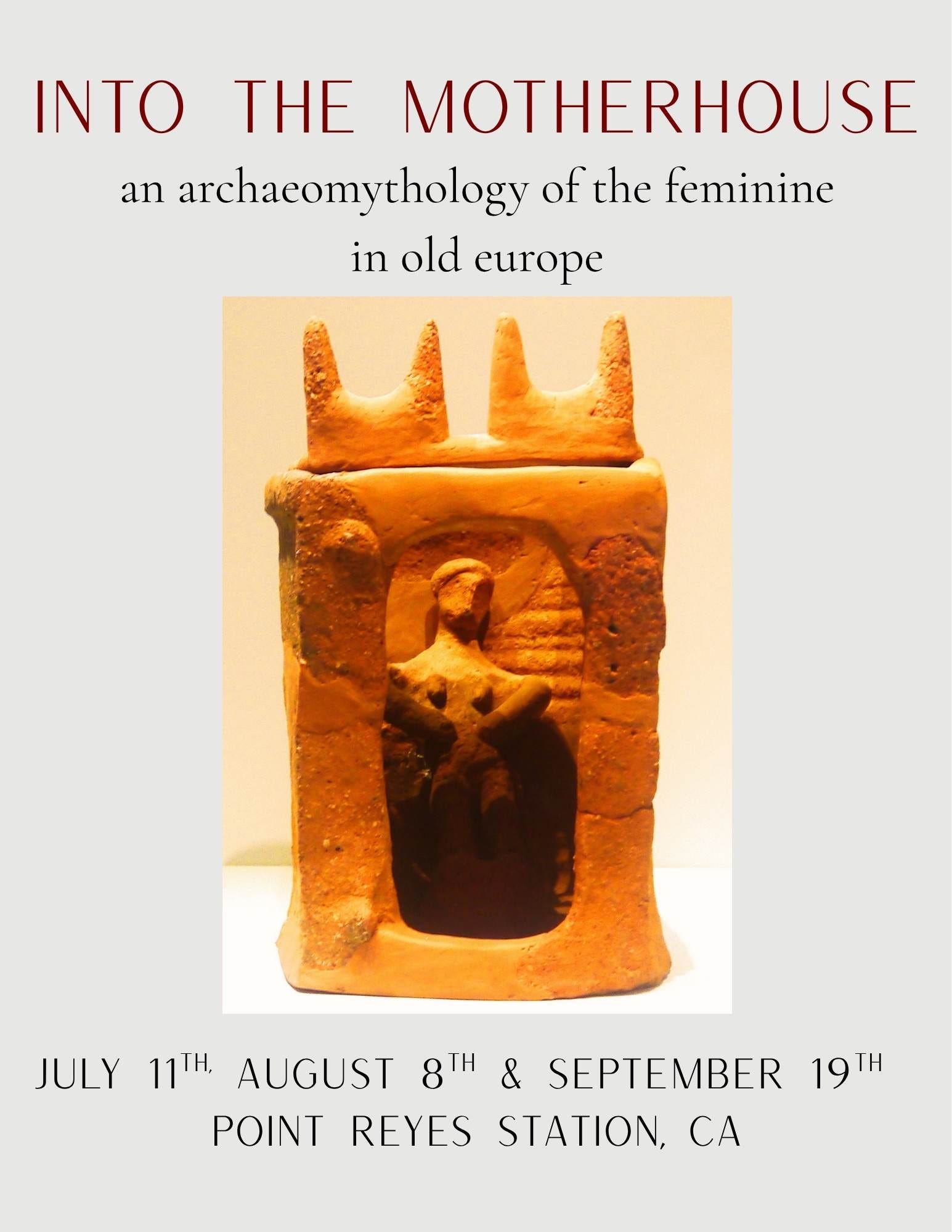
During each session Sylvia will tell a fairytale or myth, weaving it back into its root systems in matrilineal Old Europe during the Neolithic and earlier. There will be time to creatively respond to the stories through mythic writing exercises, ceramics, and textile work, and to share together in the spiraling sisterhood of the Motherhouse…
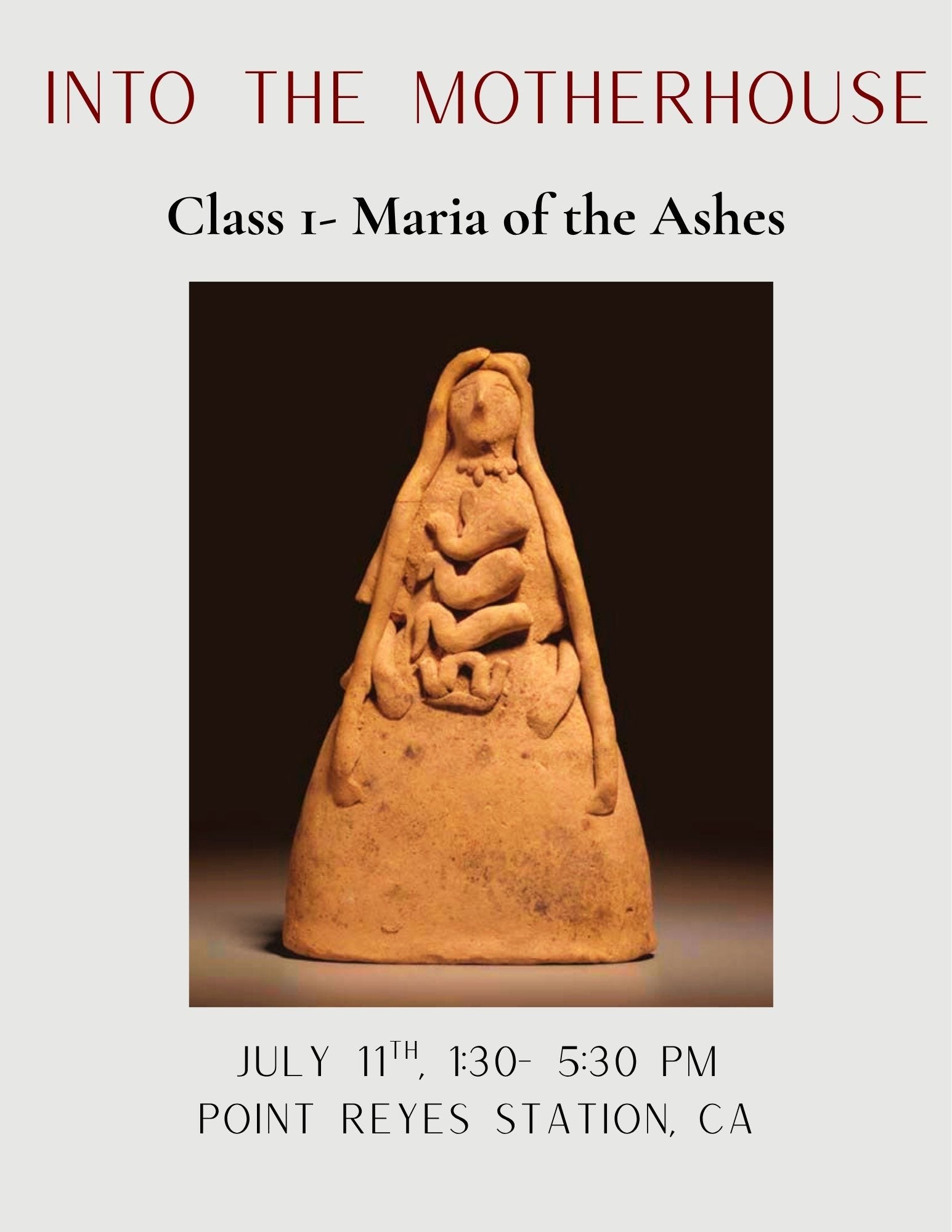
In this session, Sylvia will tell an Eastern European version of Cinderella that she calls “Maria of the Ashes.” We will discuss the sacred hearth in Old Europe, the Neolithic practice of burying ancestral bones in house floors, the ancestral nourishment contained in our motherlines, and the pre-patriarchal power of the mother cow.
We will then work with wool and drop spindles to learn how to spin our own threads, just like Maria in the story, threads that we can carry with us in order to connect back to the oldest mothering bones of nourishment in our lives.
REGISTER FOR MARIA OF THE ASHES
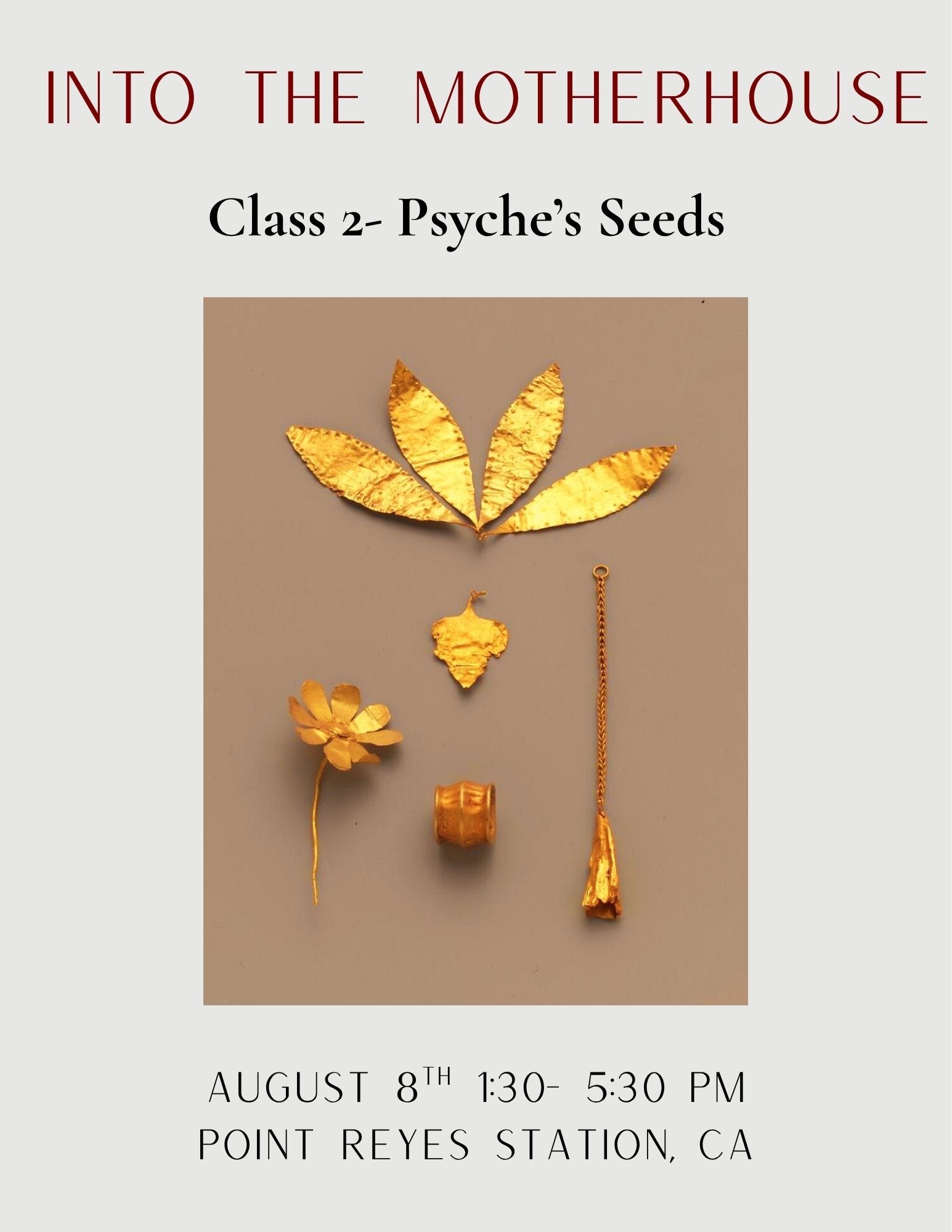
In this session, Sylvia will tell her own version of the great ancient Mediterranean tale of Psyche and Eros, taking us a step deeper into the old feminine mystery tales whose roots rest long before the days of Rome.
We will follow Psyche as she learns the language of serpents, sorts seeds, travels to the underworld, traverses ecstatic physical and spiritual love and immense despair, and births the child of her truest, deepest love. We will discuss the older origins of her initiatory activities and the great August festivals to the Mediterranean goddess of all earthly pleasure and abundance.
We will then use clay to shape our own votives in response to the story, which Sylvia will fire in her kiln and return to participants the following month.
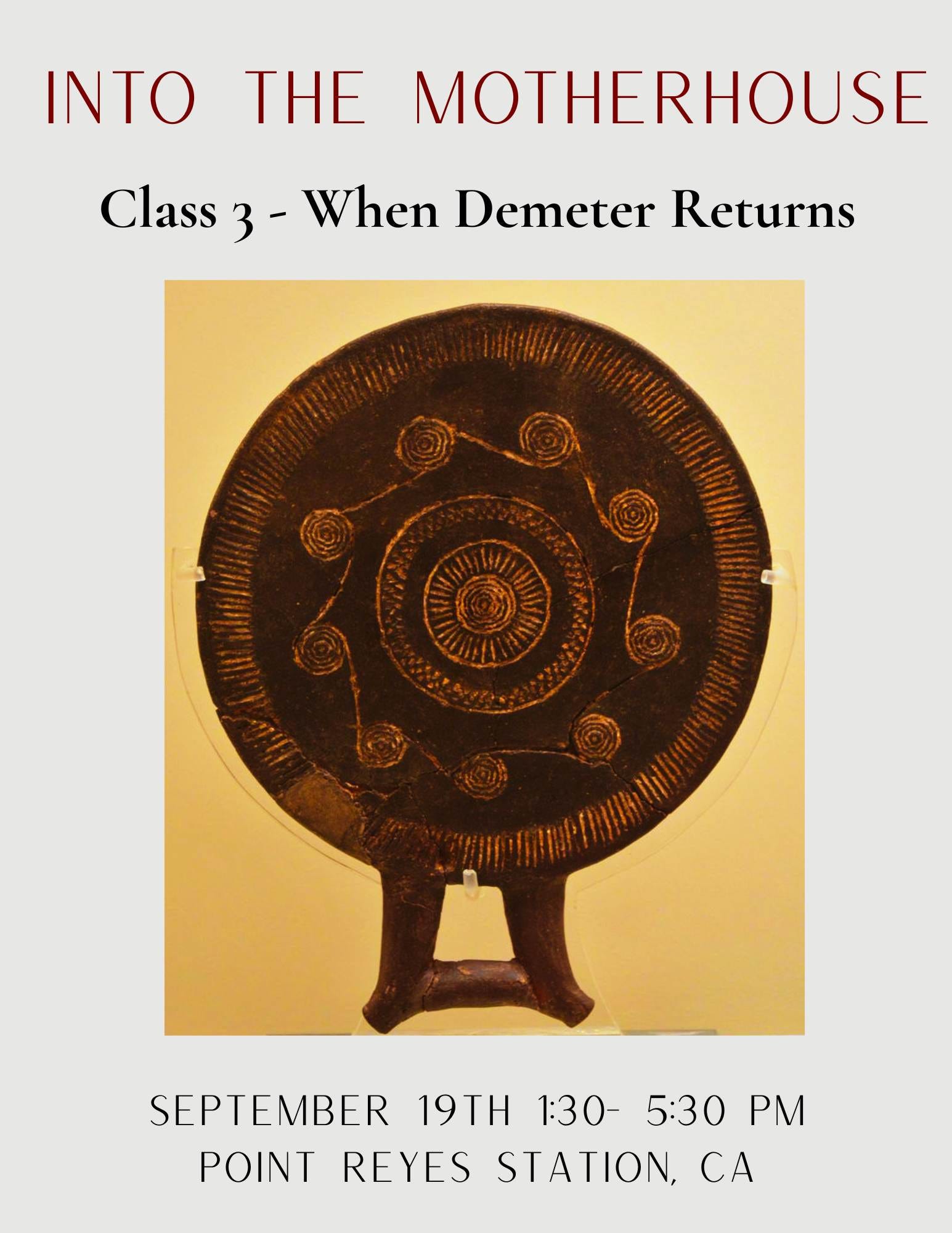
In our final session, Sylvia will tell her version of the myth of Demeter’s search for her daughter Persephone. This telling will challenge the orientation and tone of the classical-era Homeric Hymn to Demeter, rerooting this myth into its pre-patriarchal origins while also highlighting its emergence at a time in the ancient world when patrilineal law overthrew matrilineal law.
We will meet Demeter in her full-seeding, absolute abundance, not as a lesser goddess scorned by Zeus’s new laws, but as the Mother of Life, the mother who has never stopped holding her lantern high for us as we emerge again and again from the underworld back to the light.
We will work with clay to create vessels for and of Demeter, which will be fired by Sylvia in her kiln and returned to participants the following month.
REGISTER FOR WHEN DEMETER RETURNS
Emily Hauser, Mythica: A New History of Homer’s World Through the Women Written out of It ( London: Penguin Random House, 2025), 250.
If you ever leave Substack, I just want to know where and how to follow you next. I joined the platform to follow you after getting enchanted by your rendition of Tamlin, and later by the audios where you read your stories. Reading you is like being splashed with fresh water on the face, cold and salty water that carries many things that I cannot name, but feel very real.
I really needed to hear all of this, especially here and now. Thank you for pouring out such profound clear seeing and humanness! For unpicking these tangled and incredibly disturbing knots, and reflecting and looking deeply within and around at the state we find ourselves in. I am reweaving and mending my sails with the nourishment of your words, strengthened by Grandmother Moon, by this hope and truth, and earth-held wisdom. xox